
Media production, standalone brand identity
Suma Filmy Arts
From a celebrity's side project to a real home for new talent.
- Client
- Suma Filmy Arts
- Category
- Media production
- Engagement
- Repositioning and brand architecture
- Structure
- 4 phases

01The problem
What was actually broken
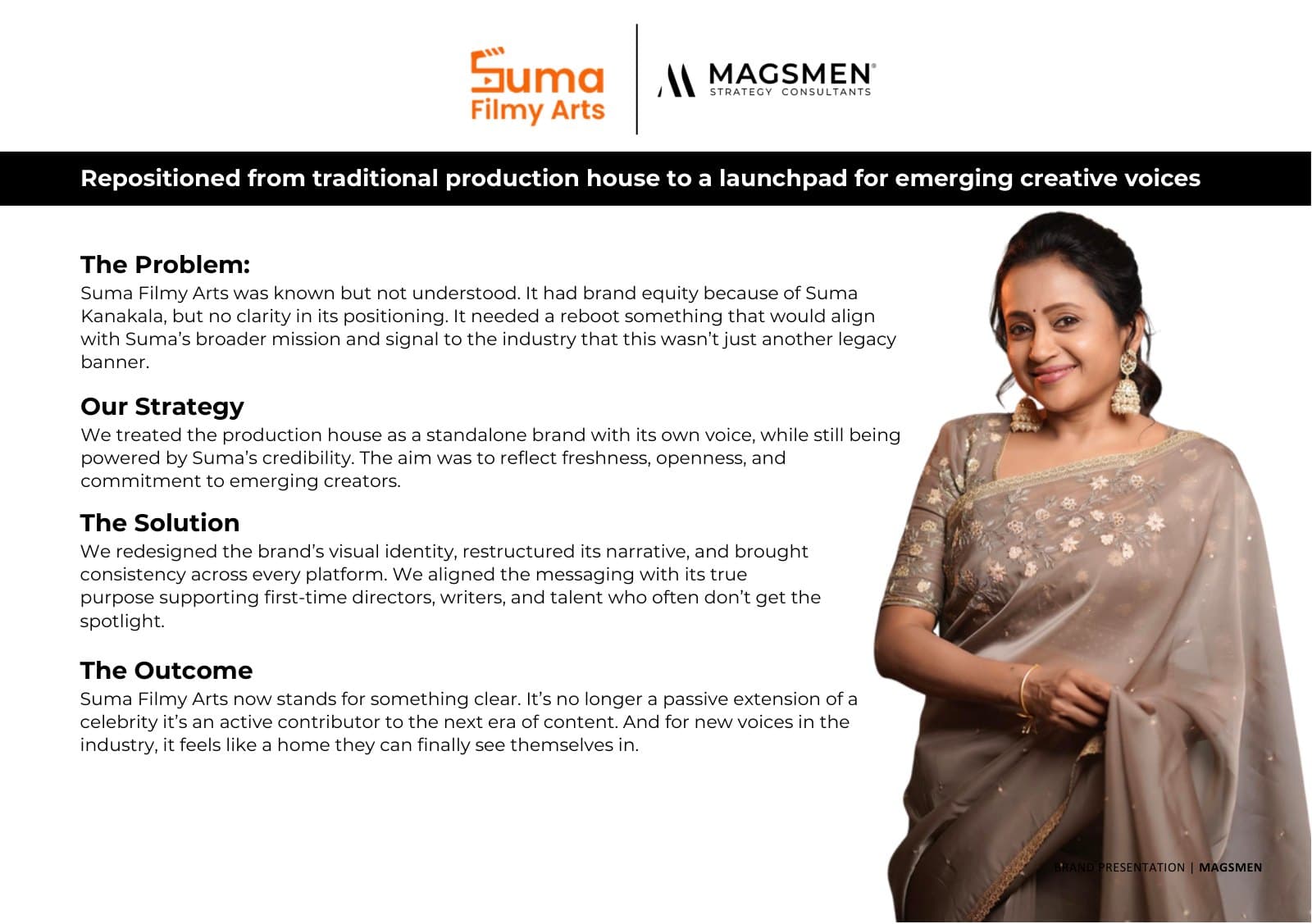
Suma Filmy Arts had real standing, all of it borrowed from Suma Kanakala's own name. But a founder's reputation is not the same as a working brand, and the production house needed the second without losing the first.
People knew the production house but not what it was. Audiences and the industry recognised the name as an extension of Suma Kanakala's fame, with no sense of what Suma Filmy Arts stood for on its own or why it mattered.
This trap catches founder-led ventures in every industry we work in. The founder's name opens the first door, but no business grows for long on borrowed attention. It needed a restart: something that fits Suma's wider aims and tells the industry this is not another banner riding on a famous name.
Friction 01
Known but not understood
Audiences and industry peers recognised the name without any sense of what the production house stood for.
Friction 02
Equity borrowed from a founder
The brand ran entirely on Suma Kanakala's own reputation rather than on an operating identity.
Friction 03
No standalone brand voice
There was nothing explaining why the company mattered beyond one person's fame.
Friction 04
Read as a legacy banner
The industry default is to file such a venture as another famous name attached to a production house.
Four forces pressing on the same brand at once. Not one of them is a design problem, which is why not one of them is answered with decoration. The engagement exists to move the brand in a single direction against all four.
02The thought process
Why the sequence ran this way
We treated the production house as something needing its own voice, still backed by Suma's credibility but not dependent on it. The aim from the start was to show openness and a real commitment to new creators the industry usually overlooks.
Two branches run from the same question, and they run together rather than in turn. The engagement converges into a finished position only once both of them have answered.
03The strategy
Four phases, each giving the next something solid.
Sequential, each with its own deliverable. Nothing here ran open-ended.
Phase 01
Purpose Alignment
We set out what the production house is actually for, backing first-time directors, writers and talent who rarely get a chance, before any design work started.
Phase 02
Visual Identity Redesign
We redesigned the identity so it stands on its own while staying connected to Suma Kanakala's name.
Phase 03
Narrative Restructuring
We rebuilt the story around actually backing new talent, rather than a celebrity lending her name.
Phase 04
Consistency Across Platforms
We made the brand consistent everywhere it appears, so the new position holds wherever people come across it.
Four phases run in sequence, each handing the next something solid to build on. The fill deepens across the row because the commitment does: nothing in a later phase is decided before the phase before it has answered.
Suma Kanakala's name remained an asset throughout. The work was to build something that still stands when that name is not in the room.
Purpose
Borrowed credibility can open the first door. It cannot, on its own, build the house behind it.
04The ecosystem
How the phases relate
We matched the messaging to what the production house is really for, backing first-time directors, writers and talent who rarely get a chance, and gave that a look and a story strong enough to stand alone.
The pipeline shows the order the phases ran in. This shows why they were never four separate projects: each phase is a different surface of the same brand, and every one of them faces the same market.
05The outcome
What changed, and why it matters
Suma Filmy Arts now stands for something clear. It is not a celebrity's side project any more, it backs new work, and new voices in the industry see it as somewhere they belong.
This holds well beyond film. A borrowed reputation opens the first door. It does not build the house behind it. That takes a purpose that stands up without the name that opened the door.
A stated purpose: supporting first-time directors, writers and overlooked talent.
A visual identity standing as its own entity, still connected to Suma's.
A narrative built on active contribution rather than passive endorsement.
Consistency across every platform the brand appears on.
A production house new voices can genuinely see themselves in.
A business no longer scaling on borrowed attention alone.
Each row moved from an unresolved state to a resolved one. Nothing on the left was decorative, and nothing on the right is cosmetic.
A borrowed reputation only takes a brand so far. The ones that last stand for something the founder's name alone cannot explain.
Other engagements.
The whole library


















We don't add busywork; we eliminate friction. We partner directly with founders to replace boardroom guesswork with executable, profitable direction.